THE UPLIFT AI WORK TOOLKIT / M&A · ECM · DCM
AI can draft the model. Would you put your name on the numbers?
Practise reviewing equity bridges, comparables, company information and transaction analysis before relying on an AI-assisted draft. Start with a fictional case, then learn a method you can repeat.
Free starting point · No card required · Synthetic practice examples, not customer results
WHAT YOU CAN PRACTISE IN YOUR FIRST SEVEN DAYS
One checked example. A method you can use again.
Work through the £580m-versus-£420m equity-bridge case. Reconcile debt and cash signs, check the reporting date, and record potential debt-like or other adjustments that need investigation.
A REALISTIC FIRST-WEEK PLAN
Take the free AI Work Check and select a task relevant to your desk.
Work through its source, assumption and calculation checks, using permitted tools.
Record what is supported, what remains uncertain and which workflow to revisit.
These are suggested actions, not guaranteed results. Practising does not certify competence.
More editorial AI updates are not currently promised on a fixed publishing schedule.
See a practical 30-day learning plan
- Week 1: Complete one synthetic example and practise the verification steps.
- Week 2: Try a filing brief or trading-comparables review.
- Week 3: Challenge a second set of sources and calculations; separate the evidence from interpretation.
- Week 4: Bookmark a relevant specialist workflow and reuse its checks in another authorised practice task.
EXPLORE THE WORK BEFORE YOU BUY
Six specialist investment banking workflows, with real detail.
Each workflow includes required inputs, a sequence to follow, an adaptable instruction, a synthetic worked answer, common failure modes and a checklist before sharing.
01Extract a company brief from filingsResearch · 20–35 min practice
What you practise: A one-page company brief with directly traceable business and financial disclosures.
Inputs to check: Published annual report and interim statements; Accounting definitions and reporting dates.
Example review check: Reporting period and currency accompany figures.
A teaching-method preview. Full steps, worked answers and adaptable instructions are available to members.
02Quality-check trading comparablesValuation · 30–50 min practice
What you practise: A defined peer set with aligned enterprise values, EBITDA periods and outlier rationale.
Inputs to check: Public peer inclusion criteria and identifiers; Observed share price date and equity values.
Example review check: All market data dates are visible.
A teaching-method preview. Full steps, worked answers and adaptable instructions are available to members.
03Audit the enterprise-to-equity bridgeValuation · 20–35 min practice
What you practise: A transparent EV-to-equity reconciliation with signs, adjustments and dates.
Inputs to check: Valuation date and enterprise value basis; Gross debt and eligible cash balances.
Example review check: EV and equity definitions are unambiguous.
A teaching-method preview. Full steps, worked answers and adaptable instructions are available to members.
04Build a source-backed M&A screening listTransactions · 25–45 min practice
What you practise: A prioritised list of potential targets with evidence and clear exclusion rules.
Inputs to check: Mandate criteria (product, country, size and ownership); Public company filings and credible announcements.
Example review check: All candidates match the product wedge.
A teaching-method preview. Full steps, worked answers and adaptable instructions are available to members.
05Build a disciplined ECM peer setECM · 30–45 min practice
What you practise: An equity-market peer framework with metric comparability and IPO-relevant differences.
Inputs to check: Issuer business model and revenue drivers; Candidate peers' public business descriptions.
Example review check: Peer selection rationale is documented.
A teaching-method preview. Full steps, worked answers and adaptable instructions are available to members.
06Reconcile a debt maturity and funding profileDCM · 30–45 min practice
What you practise: A time-bucketed maturity ladder tied to issuer disclosures and instrument terms.
Inputs to check: Debt note and instrument schedule; Maturity and currency details by tranche.
Example review check: The ladder reconciles to the debt note.
A teaching-method preview. Full steps, worked answers and adaptable instructions are available to members.
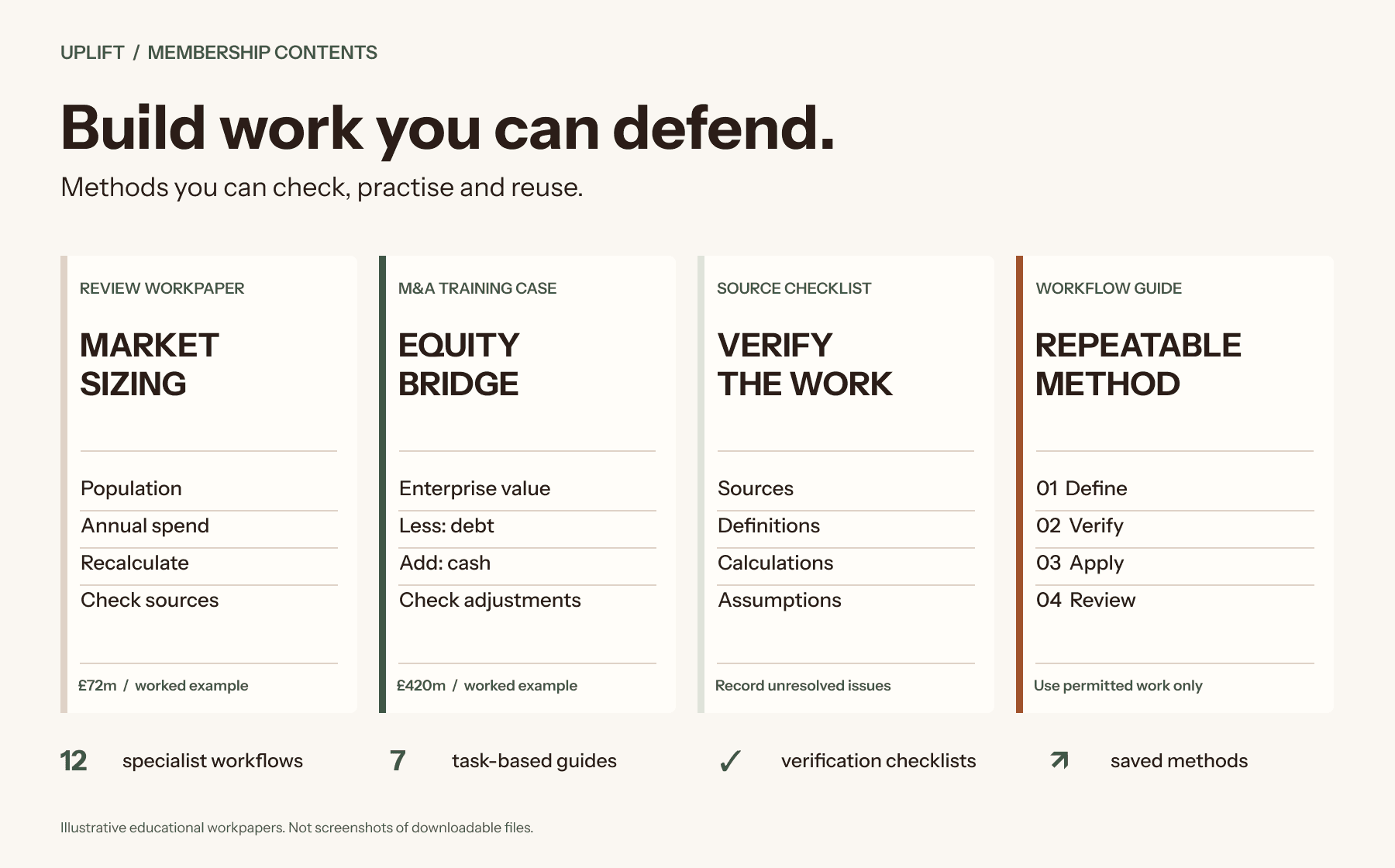
See the other six specialist workflows included in your membership
- Build a defensible market size
- Pressure-test a CDD growth claim
- Produce a sourced competitor map
- Turn interviews into defensible findings
- Audit a value-creation bridge
- Build a source-ready executive storyline
See all seven general work guides included
- Research and reading: A one-page decision brief, with each material claim linked to a source.
- Data and spreadsheets: A checked analysis with a clear question, reproducible formulas and an explanation of results.
- Financial analysis: A performance bridge and scenario explanation with explicit assumptions.
- Writing: A concise report or decision memo with a clear recommendation and evidence trail.
- Presentations: A concise, persuasive recommendation supported by a clear evidence-led slide story.
- Meetings and projects: A concise decision log, owners, dates and a follow-through plan.
- Relationships and management: A clear, respectful feedback conversation and stakeholder follow-up plan.
FROM DRAFT TO DEFENSIBLE DECISION
Four checks before you rely on the work.
Where did the claim come from?
Return to the original, permitted source and check its date and definition.
What must be true?
Make exclusions, scope and uncertainties explicit.
Does the result reconcile?
Recompute material figures, units, signs and periods independently.
What does the evidence justify?
Distinguish verified findings from judgement and unresolved issues.
How do the checklists work?
Each specialist workflow has task-specific review questions. In investment banking, these cover reporting dates, enterprise-value adjustments and the treatment of debt and eligible cash. The checklist helps you find questions to investigate; it does not approve a result automatically.
What does saving a method mean?
Bookmark specialist workflows in your member account so you can return to their review steps, worked examples and reusable instructions. Saving a method does not store client files or execute analysis on your behalf.
What the Uplift AI Work Toolkit is not
- Not a job, promotion or redundancy-protection guarantee.
- Not a replacement for your firm's approved AI tools, data policy or supervisory checks.
- Not a live data platform or an automated certification of professional work.
- Not a generic prompt library: instructions sit within complete workflows and verification steps.
QUESTIONS BEFORE YOU JOIN
Clear answers, before payment.
Is this only for people already using AI?
No. Start with synthetic examples and the free AI Work Check. Practise the verification method even if you do not have access to a paid AI tool.
What if my firm restricts AI tools?
Your firm's policies take priority. Use fictional training materials to learn the method; only use approved tools and data for actual work.
How is this different from a generic AI prompt library?
Each specialist workflow includes required inputs, a step-by-step method, an adaptable instruction, a worked answer, common failure modes and review checks.
Can I cancel anytime?
Yes. Cancel future renewals from your account or by contacting Uplift. Cancellation does not automatically refund a period already paid for. Read the terms and 30-Day Action Guarantee.
A convincing model is not enough.
Know what to verify, what remains uncertain and what you can responsibly defend.
Take the free AI Work CheckThe AI Work Toolkit is the primary product for new members. Existing members retain their prior access entitlements. Previously included Uplift resources remain available through the member account.